Copilot Cowork is now generally available

What does this mean in practice?
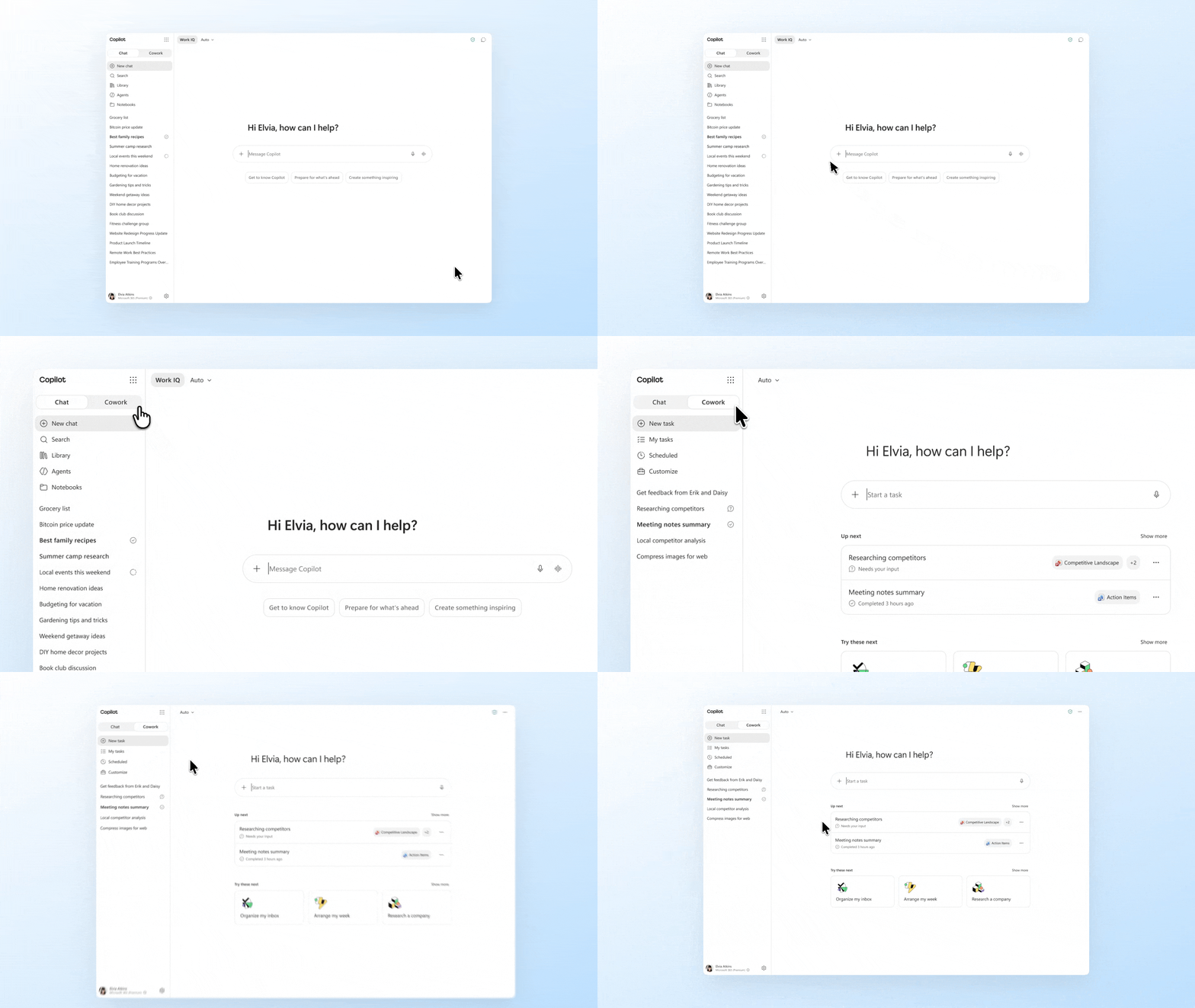
For a long time, Cowork was only available in the Frontier Preview. This has now changed. On June 16, 2026, Microsoft announced the general availability of Copilot Cowork. This gives every organization with Microsoft 365 Copilot access to an agentic system that can independently execute complex, long running tasks.
As a Microsoft partner, isolutions provides context around this announcement. What can Cowork do, where does it add value compared to the classic Copilot, and most importantly, what questions now arise around cost management, governance, and adoption. This is exactly where our support comes in.
At a glance
- Cowork has been generally available worldwide since June 16, 2026
- It executes complex, long running multi tool tasks end to end and delivers finished results instead of drafts
- A new usage based pricing model called Copilot Credits introduces new considerations for cost management and governance
- Cowork is disabled by default. Activation, budgeting, and adoption should be managed deliberately
What is Copilot Cowork?
Added value
Added value compared to the «standard» Copilot
Microsoft 365 Copilot (USL with a fixed price per user per month)
- Copilot Chat as well as Copilot in Word, Excel, PowerPoint, Outlook, and Teams
- Work IQ context engine and multi model intelligence
- Pre built agents such as Researcher and Analyst and custom agents via Agent Builder
- Predictable fixed pricing per user per month
Copilot Cowork (usage based, on top)
- Agentic system for complex, long running multi tool tasks
- End to end execution with a finalized result instead of a draft
- Plugins, browser usage via Edge, and model selection per task
- Billing in Copilot Credits and only for actual usage
In short: the classic Copilot supports you in the moment of work. Cowork takes on entire work packages. This requires a clear understanding of usage and cost.
New pricing model
The new pricing model: usage based in Copilot Credits
Copilot Cowork is billed on a usage basis, denominated in «Copilot Credits». The cost per task is determined by four factors:
- Model usage which model is used and how much
- Context retrieval how many knowledge sources are referenced
- Tool calls which tools are used and how many
- Runtime how long the task runs
Microsoft observes three typical task patterns light, medium, and heavy, as well as four user personas with different usage behaviors. Based on the combination of personas, task mix, and price per prompt, cost estimates can be modeled and refined over time.
Models and payment options
Models at GA
Anthropic Opus 4.8 and Sonnet 4.6 with GPT 5.5 additionally available in the Frontier program
Cowork 1
Proprietary cost efficient model coming soon, optimized for everyday tasks at significantly lower cost
PayGo
Pay as you go with maximum flexibility at $0.01 per Copilot Credit
P3
Upfront commitment to a usage volume in exchange for discounted pricing
Key customer question
The key customer question: how do we keep costs under control?
A variable pricing model creates clear value, but it also introduces the risk of costs increasing unexpectedly if many employees use Cowork intensively. Microsoft addresses this with cost management capabilities across three areas: control, transparency, and efficiency. The good news is that Cowork is disabled by default. Nothing runs until you explicitly activate it.
1. Control which defines when, who, and how much
- Activation control: Cowork is off by default. Admins decide when it is enabled in the tenant and who gets access.
- Spending limits: Spending limits can be defined at tenant, group, and user level. Scoped billing policies allow budgets to be set, including user caps within group policies.
- Configurable alerts: Admins define relevant thresholds and determine who is notified once spending exceeds them.
- User credit requests: If additional credits are required for a task, users can request them directly within Cowork in a controlled manner rather than consuming resources without oversight.
2. Transparency which shows what is used and what it costs
- Usage reporting: Usage is broken down by user, group, and feature, with clear attribution across the organization.
- Cost per task: Users can see the cost per task in credits while executing it. This capability becomes available shortly after general availability.
3. Efficiency which provides levers to manage costs
- PayGo vs P3: Flexible pay as you go billing or upfront commitment with discounted pricing depending on maturity and planning needs.
- Model selection: Through the model picker in the Frontier environment, costs per task can be optimized by choosing the appropriate model.
Important for the transition phase
Billing for Copilot Cowork starts from the date of general availability. Tenants that had at least one active Cowork user during the Frontier program from March 30, 2026 to June 16, 2026 receive a grace period and are only charged starting July 1, 2026.
The adoption factor
When to use which agent or model?
The usage based model makes a question business critical that previously felt more technical: when is it worth using Cowork and which model should a task use? Model usage, context, tool calls, and runtime directly determine the cost.
- A «light» task with only a few sources generates different costs than a «heavy» task with broad aggregation and deep reasoning.
- A powerful Frontier model is not required for every task. For many routine activities, a more cost efficient model is sufficient, for example Cowork 1 in the future.
- Employees need to develop a clear sense of when the classic Copilot is sufficient and when Cowork justifies the additional effort and cost.
This understanding cannot be enforced through policy alone. It is built through targeted adoption and enablement. This is exactly where isolutions bridges the gap between technology, cost, and user behavior.
Further updates
What else is new?
Enablement by isolutions
Support by isolutions across four areas of action
The capabilities are in place. What matters is using them securely, efficiently, and with impact. We provide guidance across four areas of action:
- Secure activation and governance: enable Cowork deliberately, define access scopes, and set budgets, limits, and alerts before usage scales.
- Cost transparency and FinOps: leverage usage reporting, model personas and task mix, evaluate PayGo versus P3, and establish a reliable cost model.
- Adoption and enablement: empower employees to understand when Cowork is the better choice over the classic Copilot and which model fits each task type.
- Value and ROI tracking: compare the value created with the cost to ensure transparency on investment and business impact.
Next steps
Interested in introducing Copilot Cowork in a secure and cost controlled way? Get in touch and we will jointly define governance, budgets, and an adoption approach tailored to your organization.

